Articles Posted in Fishing Industry

Published on:

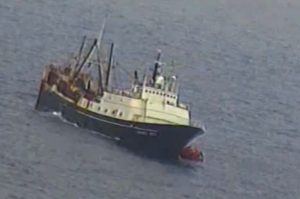
Rscue-300x199Two weeks of Coast Guard hearings and testimonies this past month are slowly revealing the mystery behind the July 26th sinking of the Alaska JURIS that forced 46 crewmembers to abandon ship in the Bering Sea. Chief Engineer aboard the JURIS, Eddie Hernandez, was a key witness for Coast Guard attempts to reveal operations of the vessel’s owner, Fishing Company of Alaska. The company teams with a Japanese fish buyer, Anyo Fisheries, and continues to operate three factory trawlers whose crews process and freeze catch.

This is not the first time that Fishing Company of Alaska has been at the center of a major Coast Guard inquiry. In fact, many issues that surfaced during the Alaska JURIS hearings paralleled the 2008 sinking of FCA’s Alaska Ranger. In both instances, there were reported gaps in a Coast Guard inspection program, chronic vessel maintenance issues, and safety conflicts between a U.S. crew and Japanese workers.

Although the report on the Alaska JURIS is not expected for months, the hearings offered a look at conditions and operations aboard the vessel. Crewmember Carl Lee Jones revealed in testimony problems surrounding rusting pipes, run down crew quarters, and Japanese crew members who refused to participate in safety drills.

Published on:

On the morning of Wednesday, July 27th, crewmembers aboard OCEAN PEACE and SEAFISHER were focused on the harvest of Atka mackerel. Some 55 miles away, another trawler vessel, the ALASKA JURIS, was taking on water.

Upon receiving this distress call, the two vessels halted fishing and processing to begin the 6-hour journey to rescue the JURIS crew. All 46 crewmembers once aboard the JURIS were safely transported to the Aleutian Island port of Adak by Thursday evening.

“They said we got to go, and we’re on it,” said Todd Loomis, an official with Ocean Peace Inc., which operates the two factory trawlers.

Published on:

At around 11:30am on Tuesday, July 26, Coast Guard 17th District watchstanders received an electronic position alert from fishing vessel ALASKA JURIS. The vessel had been traveling in the Bering Sea near Alaska’s Aleutian Island chain, 150 miles northwest of Adak when it began taking on water. Coast Guard contacted the crew directly, confirming that the 220-foot vessel was in distress, and all 46 crewmembers had begun donning survival suits and boarding the three life rafts.

The Coast Guard issued an urgent marine information broadcast to surrounding vessels, and sent a Kodiak HC-130 Hercules airplane and two Kodiak MH-60 Jayhawk helicopters to the scene. Vessels Spar Canis, Vienna Express, Seafisher, and Ocean Pease diverted to assist. Seas were calm at the time of rescue, though heavy fog presented poor visibility. ALASKA JURIS crewmembers boarded Good Samaritan vessels around 5:00pm, and began the 13-hour voyage to Adak, AK.

Lt. Joseph Schlosser of the U.S. Coast Guard reported to the Alaska Dispatch News that preliminary information suggests the sinking could be tied to mechanical problems in the ship’s engine room. Definitive cause remains under investigation. There are no reports of injuries.

Published on:

Icicle Seafoods, Inc., a major harvester and processor of wild and farmed seafood in Alaska and the Pacific Northwest, is for sale. Private equity investment firm Paine & Partners bought Icicle in 2007 and is now looking for a buyer.

Icicle Seafoods began in 1965 when a group of employees and fishermen in Petersburg, Alaska bought the Pacific American Fisheries cannery. The company has grown to own and operate on-shore canneries in Seward, Homer, Egegik on Bristol Bay, Larsen Bay on Kodiak Island, and Wood River out of Dillingham. They also own and operate processing ships and fishing boats throughout Alaska and process salmon, pollack, and crab.

Icicle also runs a farmed salmon business in the Pacific Northwest, with farms at Bainbridge Island, Cypress Island, Port Angeles, and Hope Island, WA. They also expanded to a farmed salmon venture in Chile, raising and selling farm-raised coho and Atlantic salmon.

Published on:

Newport Fishermen’s Wives and the Newport, Oregon community fought hard and won the one-year extension of the U.S. Coast Guard’s Newport helicopter base.

Fishermen’s Wives of Newport, a non-profit, and co-complainants sued the Coast Guard when the Newport air station was slated to close due to budget ills. Their lawsuit states that closing the air station violates the Coast Guard’s legacy missions including marine safety, search and rescue, and aids to navigation.

On December 11, Congress passed a bill that prohibited the Coast Guard from closing the Newport air station. “It was an enormously impressive effort on the part of stakeholders and the community to challenge this on all fronts: politically, in the press and in the courts,” said Fishermen’s Wives of Newport’s attorney Michael Haglund. The helicopter base in Newport will remain open until January 1, 2016.

Published on:

Many ambitious hopefuls or romantic souls dream of flying to Alaska in the summer to win the salmon season lottery. I was one of those dreamers and fortunately worked in Bristol Bay for 10 summers. Although I didn’t get rich, I am rich with memories of hard work, camaraderie, and the long and light days in Naknek, Alaska.

There are many other Alaskan fisheries to work in besides salmon, however. Here’s a list of fisheries and opening dates compiled from information from Laine Welch, a Kodiak-based fisheries journalist.

January 1: Boats with hook and line gear or pots will fish the Bering Sea and Gulf of Alaska for Pacific cod, rockfish and other groundfish.

Published on:

In 1976, the Magnuson-Stevens Fishery Conservation and Management Act was passed in response to the large number of non-U.S. fishing vessels in our waters, and the seriously reduced, threatened fish stock resulting from years of overfishing by non-U.S. and U.S. vessels alike. From the passage of this Act onward, the U.S. claimed a 200 mile Exclusive Economic Zone (EEZ) wherein only U.S. vessels can fish. The Act also gave the U.S. government the power to make and enforce regulations and laws to protect fish and other sea life, and thus the livelihoods of those working in our commercial fishing industry.

The Act has been reauthorized with new amendments twice so far since 1976, once in 1996 and again in 2006, but expired as of this past September. In keeping with the general state of factionalism in the U.S., there are two conflicting versions of bills offered in order to reauthorize the Act this fourth time. The lines are split between the Democrats and Republican bill committees, which just happens to mark the differing needs and ideologies between the U.S. Pacific Ocean fisheries and the U.S. Atlantic Ocean and Gulf of Mexico fisheries.
Continue reading

Published on:

American Seafoods Group, one of biggest commercial fishing companies involved in the Alaska pollock fishery, has sold their east coast seafood processing business, American Pride Seafoods. The sale to High Liner Foods was announced October 1, 2013. High Liner Foods reportedly paid $34.5 million for this subsidiary of American Seafoods. The American Seafoods sale of American Pride Seafoods marks a departure from the company’s previous sea-to-plate market integration.

American Pride Seafoods is a value-added frozen seafood and scallop processing business with revenues of $190 million reported in 2012. Typical products include breaded seafood products such as fish and chips, frozen seafood, and seafood packaged for use by restaurants and retail food providers. High Liner Foods indicated that they intend to continue to operate American Pride Seafoods at the New Bedford location without any substantial changes at this time.
Continue reading

Published on:

On January 30, a 23-year-old fisherman was air-lifted from F/V NORTH SEA, a Seattle-based Coastal Villages Region Fund crab boat. According to reports, NORTH SEA crewmembers called the Coast Guard that afternoon when the man was seen suffering seizure-like symptoms.

According to the Coast Guard, NORTH SEA was about 60 miles southwest of St. Paul, Alaska, at the time. Conditions at the time are said to have been 6-foot seas and 29mph winds. The Coast Guard deployed a Jayhawk helicopter from Air Station Kodiak and airlifted the fisherman to St. Paul for medical attention.

Published on:

As written previously, commercial fishing remains the most dangerous job in the United States. Alaska has a higher worker fatality rate than the rest of the U.S., partly because about 25% of commercial fishing related deaths in the U.S. occur in that state. According to a 2010 National Institute for Occupational Safety and Health (NIOSH) report on commercial fishing fatalities, falls overboard constituted 31%. Vessel disasters, such as sinking, constituted another 51%. A grim fact stated in the NIOSH report is that, of the 170 fall overboard fatalities between 2000 and 2010, none of the victims were wearing a personal flotation device (PDF).

Some people argue that there’s no reason to wear a PDF in cold seas because a person would die within two or three minutes from hypothermia. However, for the average healthy person in cold water, it takes hypothermia about 30 minutes to set in. In truth, wearing a PDF adds survival time pending rescue because it keeps you afloat even after you are too cold to move (but are still alive and able to recover). Remaining afloat also keeps you more visible to searchers, especially if your PDF has reflective tape and strobe lighting.
Continue reading

Contact Information